Showing posts with label Challenges. Show all posts

Friday, 11 January 2013

Best Wing Forward!!

                Hello, you lovely people,


Here we are twelve days into the new year and already I am focusing on the direction ahead. I get so excited at the start of each year, making plans and decisions for the future month's ahead.


Over the past year, I have learned a great deal about social media, blogging, tweeting and keeping my posts up-to-date. Strangely enough I found it all quite tedious to begin with but laterally I'm pleased to admit I'm actually getting to grips with it and enjoying it all so much more.


This year, I will write my thoughts and plans on my post and publish them. I must confess I am inclined to procrastinate so, I feel I will accomplish so much more being aware you all know my plan and by the end of 2013, I will have completed all my tasks!!


Apart from my floristry business which I am very passionate about and love, I have signed up for Goodreads 2013 Book Challenge. I will read one book per month over the following twelve months. I appreciate most of you will be completing many more books but I feel this would be a good challenge for me... Yeah!

I intend to update Natural Twigs n Spices and my new blog The Quartz Rose which is going to be an extension of my website www.myflowerpot.co.uk but with a twist and involving meditations, healings and in time, treatments and courses. I will write one post per week  for each blog to begin with. My challenge on Twitter, will be to reach 4,000 tweets with quotes on various topics, recent news updates, retweets and any other subjects or gossip by the end of 2013! Yeah!!

I started a Creative Writing Course sometime back and floundered badly along the way, so I have decided to pick up where I left off and continue the course.  I  hope to be closer to my dream this time next year if not before. So here's to a "Best wing forward and finding my writer's voice".

What are your plans for 2013 and are you starting any new businesses?
Any suggestion would be very welcome. So please leave a comment, I don't bite or sting!! 

Sunday, 16 September 2012

Taking The Plunge!


Have you ever felt your clothes are a little to tight or your skin is looking saggy and not at it's best. I recall a few years back when I was desperately overweight. Looking into a mirror and feeling ashamed of my body. I felt old, frumpy and my joints ached. Just walking or moving around began to feel impossible and generally my mental attitude took the plunge.

Two years ago, I was fit and full of energy, I was always busy, competing horses, swimming, visiting the gym and walking .. I never felt the need to check out my diet or keep an eye on my weight, until the past year when I felt that all of my energy and fitness had just got up and went.  Recently, I came across Indigo Horizons which at that time was covering a fitness regime. I thought whey hey, perhaps I should try this and see if it can help me.

Up until recently I lived in the country where I always felt at ease with plenty hill walks and moors to lose yourself on and  lovely people, I knew well. It's only been recently since moving - down to the north-east that everything has changed.  I'm not meaning to sound pathetic but since I became more involved with the Internet my exercise regime went out of the window. Time seemed to fly by and in very short space of time my muscles became soft, my body sagged and junk food became my diet.. In fact I gradually became a fat slob!

Since reading Indigo Horizons  I have been cutting out the junk food and eating a more healthy diet. I am walking regularly, riding my horse more often and although my joints are still painful  I am walking more and cycling when I have spare time. I feel now that it has improved my attitude for instead of procrastinating, I am sitting at my desk and writing this post which is long overdue.

I wonder if perhaps you have felt like I did and if you tried anything to improve your fitness and state of mind. I look back on it now and I'm pleased I took the plunge!!

Saturday, 2 June 2012

KREATIV BLOGGER AWARDS


                     Designed by KATIE O'SULLIVAN

I know I have completed my post for random facts regarding both  My Lovely Blogger Award and Kreativ Blogger but it wasn't until now that I realised they are actually separate. So I have decided to give this Kreativ Blogger Award by Kate O'Sullivan the credit it is due together with seven random facts  also.

So here they are albeit a little shorter than before.
  • Although I'm blonde in the profile picture my hair is now actually dark with highlights which is my natural colour.
  • My eyes are hazel and my skin is quite brown due to being out in the elements.
  • I wear contact lenses but when writing I sometimes wear plus twos as well.
  • I enjoy reading and -writing my blog and would like to write my own book at some point. I I'm working hard to become a good blogger. I  enjoy reading but the book must have me gripping my seat with a twist in it. I have recently read Jim Browns latest Novel BOOM!! Which was awesome.
  • I was a bit over weight about nine months ago but now I'm slim to medium build Which I do prefer.
  • My favourite colours are green, pink, deep blues, Creams and greys except yellow and browns sadly - I don't suit yellows and browns.
  • I am a great one despite all my efforts for arriving late, I don't like to be late for anything

Well these are my seven random facts which give you a little information about me. To be honest, I feel this post is perhaps the way I should  go and avoid getting to intense. Well thank you for popping by and reading my post. The people I have nominated for this Lovely Kreative Award are as follows:-

Denise Mitchell http://www.cupcakesandcadenzas.com/
Bob Scotney - Bob Scotney
Shannon King - Shannon King
Mooderino - http://moodywriting.blogspot.co.uk/
Mama Diaries -http://sherryellis.blogspot.co.uk/
L Diane Wolfe - L Diane Wolfe

Thursday, 17 May 2012

Seven Random Facts About Me


I would like to say thanks to Siv Maria. for this  Lovely and Kreative award and I love it. However I must continue circulating it throughout the land of blog which of course means I must share Seven random facts about myself and then pass these awards onto other blogger's. The awards were designed by two lovely ladies, with beautiful personalities. I  hope I can do the award justice and to include any random facts that may make you smile. So here's "looking at you all!" 
  • Well I'm not sure if I'm very random these days, although perhaps I should leave it for you to decide. Some years ago I decided to do things for me instead of everyone else. I have a desire to cure my tremor. This is not perhaps the medicinal way of curing the problem but it's my theory and I shall leave it for you to ponder on whether you think it's a good one or not! 
  • For my 50th birthday, I decided I would try everything I had never done, at least once. I have always been interested in living on the edge and I am very competitive once I have the hang of it. The first experience was to fly a glider which I did and loved. The second was to zip-wire off the Tyne Bridge, this one I have yet to carry though. Most of all I have a desire to para-glide on my own.. I just cant wait for the thrill. My friends and family think I'm bonkers!
  • As I love being outdoors, I'm at my happiest when out visiting friends, riding my beautiful thoroughbred grey horse Alfie. Neither of us are spring chickens but we both enjoy a good power stroll through the forestry. Once a year we parade fully plaited and turned out looking frightfully smart for our five minute jaunt at Christmas time where  show everyone how stiff we both are to the melody of "Here Comes Santa Claus," its Alf's high light of the year and if he is happy then I am too!
  • I look after my father, as well as taking orders, making bouquets and delivering them. Writing my blog post, keeping my website up-to-date.  Riding, teaching, healing, and  the usual chores. However, when the"sun his hat on," I'm off with the work clothes and on with the shorts, jump into the car, shades on and head to the beach". To the wide open spaces, the ocean and golden sand and me. At that time of the day either, "No-one will have surfaced or they will have all gone! That's my idea of peace and most importantly "freedom" together with Cream and the music;  Dance floor is like the sea, Ceiling is the sky. You're the sun and as you shine on me,  I feel free, I feel free, I feel free.                                  Lyrics by Jack Bruce
  • When I was younger I loved my job and ended up giving every minute I had to it, eventually becoming its slave. I worked long unsociable hours and the years passed me by. I had my family I miscarried my first, a little sadness on my part there. Later my daughter arrived. My marriage dissolved so I ended  struggling to bring her up on my own. Now I look at my daughter and I'm so proud of her, she has accomplished all the things I'd want her to. It would be lovely if she met a nice man to give me some grandchildren.
  • I love socialising, going out for meals with friends and occasionally a handsome gent but that doesn't happen very often. I'm not a red meat fan. I love fish which is my main diet. I love all fruit and vegetables and can eat fish raw or cooked, I'm easy. I like All types of food provided its not swimming in grease, Hot and spicy, Cantonese, Chinese, Italian and Indian is good too.  I love good full bodied red wine Merlot which is my favourite but white is okay on occasion too. Champagne is delicious but I'm not rich enough to drink that very often - sadly!
  • I love all types of music, "Smooth" music, BBC 3 Classical FM and radio BBC 4, Where would we all be with out them. and still do but I have found I'm becoming more fond of Radio four. Is that a sign I'm getting old, do you think. I love listening to a good story on radio four. If all else fails I read a book. Although recently I tend to live sleep and drink on the Internet and in that order.

Thank you funny and beautiful  Siv Maria for these lovely awards. Please make sure to check out Siv's blogs post, with her interesting fairy stories from Norway and visit Judy Garland with her magic red shoes.  Also the  LOVELY MELYNDA and CREATIVE KATIE O'SULLIVAN  together with their great blogs. Here are my picks for random exposure, no pressure feel free to use them as you wish.
These are the blogs I think are creative.
Bob Scotney - Bob Scotney
Shannon King - Shannon King
Mooderino - http://moodywriting.blogspot.co.uk/
Mama Diaries -http://sherryellis.blogspot.co.uk/
L Diane Wolfe - L Diane Wolfe

Friday, 11 May 2012

My Reflections!

April 30 2012, the April Blog Challenge came to an end.

My theme was Cambodia although I wont say it was an easy theme. I am happy to say that it was both enjoyable and it took me back down memory lane. Due to the different themes which were chosen not everyone would have managed to complete every letter  but we all gave it our best shot. Cambodia seemed to be the one thought that sprung to mind when I first signed up to the Challenge. Not sure what I was getting into I went along with the theme.

I enjoyed the researching of each letter, it certainly gave me something to get my head into and I met some of the most  delightful people at the same time. Which made it so much more worthwhile. Since the start I have covered everything from flying experiences to travelling in junks, visiting temples, finding information on birds, animal, fish and reptiles most of which turned out to be endangered or red listed.

I appreciate that Cambodia is not everyone's cup of tea. This has been a first time I have ever applied myself to writing regularly every day since I was at college. It has been very good for me, as like many of you, I am inclined to procrastinate. Whilst on the challenge I have worked my way through so much more than I would have done in a normal day. From here on in, I am hoping to write and post each day with new topics and planning each of my days as though the challenge is still running. I would certainly pick a theme again for 2013 if I am still around. There were some interesting story posts. which I thoroughly enjoyed reading

So let us all pop open a bottle of Champagne, Wine or Sparkling water and whatever your tipple and pour ourselves a glass of whatever appeals and let us raise our glasses.;-

To our Hosts
Thank them for making the April 2012 Blog Challenge so enjoyable, and thank them for all their hard work.
Let us also raise our glasses and thank every one who joined in for all of their support and guidance and Last but not least

"3 Cheers" to everyone including ourselves and a big pat on the back for all our hard work. 


" HIP, HIP, HOORAY! HIP, HIP, HOORAY! HIP, HIP, HOORAY!!! " 
Oh and before I go. 

Sorry I'm four days late but doc say's I will be in bed for at least another five days!! 


Monday, 30 April 2012

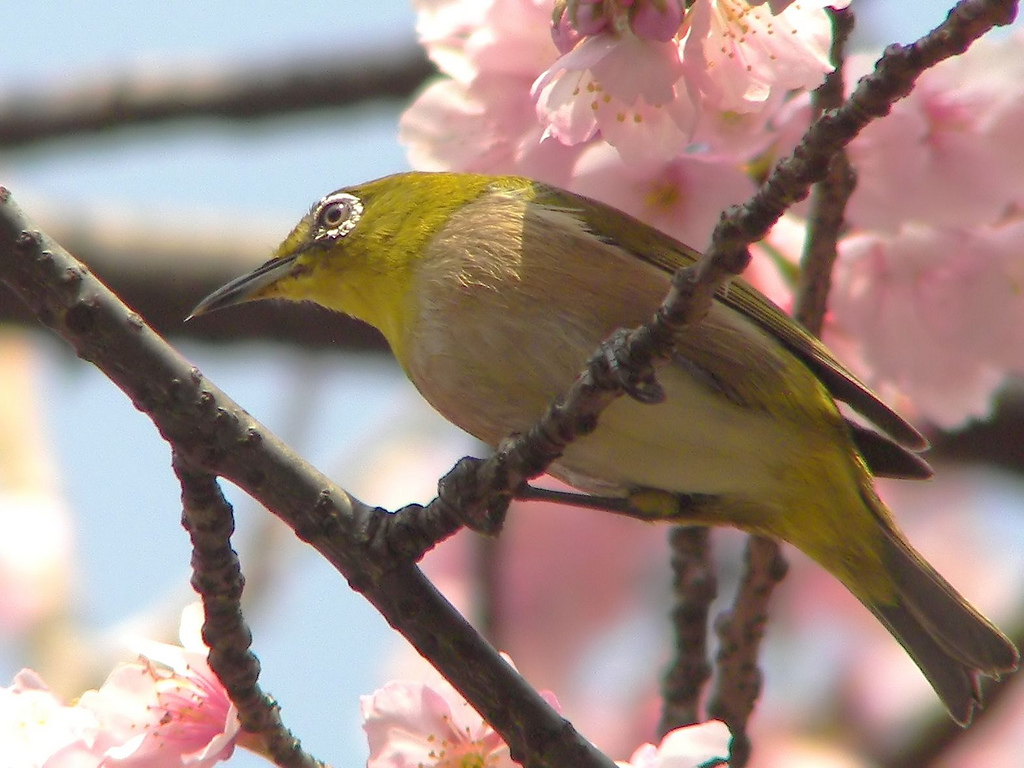
Z: Zosteropidae palpebrosus( Oriental White Eye Warbler)

Oriental White-eye - Zosterops palpebrosus
Oriental White Eye Warbler
Zosteropidae palpebrosus (The Oriental White eye Warbler )

This sub-tropical bird is found mainly in  China as well as Cambodia and throughout Asia. It is a migratory bird and they do their mating in northern China. They migrate in the winter season to South Asia.

These pretty little birds are only 8-9 cms and are very distinctive with their yellow marking over their heads, necks and plumage. This makes them easy to be seen.

They go around in small groups and live on nectar from the flowers and small  insects. There are several different species and they all come in a variety of colours. Which places them in the sub-species.
To find out more Click on the link here http://www.avianweb.com/orientalwhiteeyes.html


Chestnut White Eye Warbler


Zosteropidae erythropleurus Chestnut Flanked White Eye Warbler

This species is Red listed Endangered and can be seen in Cambodia's bird sanctuary where they are safe.
These birds make theirs nests high up in the trees of the Poplar, Alder, Willow and both varieties of deciduous and evergreen trees and forest. They will lay up to three eggs per nest.

To learn more check out the link here http://www.avianweb.com/images/birds/ChestnutflankedWhiteeye.jpg

Saturday, 28 April 2012

Y: Yellow ((Hieremys annandalii)


Y: Yellow (Hieremys annandalii)  which I hope you will find interesting, I certainly did.

Y is for Yellow and today, I will introduce you to my little friend the -Yellow headed Temple Turtle. These are very large aquatic turtles and they live in the pools and canals around the Buddhist Temples. They have no teeth  as they live on the vegetation and water lilies. Their colouring is interesting with yellow decorative stripes around its head. and under his shell. The top of his shell has two black spots one on either side when young. As he becomes and adult the spots become larger and blend together.

In Cambodia they are found in pools and canals close to the Buddhist temples. They prefer damp wet  evergreen forests and flood plains. when in the rivers, they prefer slow running water.

Friday, 27 April 2012

X : Xenophrys (Megophrys) auralensis


Horned Green Frog


Xenophrys (Megophrys) auralensis | Aural Horned Frog

There are four new species of frogs which have been found in the Cardamon Mountains and here I hope to tell you a little of Xenophrys (Megophrys) auralensis, as this post is about the letter Xenophrys.

Xenophrys (Megophrys) auralensis is the latest species found on the "Phnom Aural" Cardamons highest mountain in Cambodia and is to be viewed at the Phnom Aural Wildlife Sanctuary.  This frog has green blood and purple bones and measures 76.7 mm long. They prefer a damp moist area where it is cool, under leaves at the edge of green forests and approximately 250-300 metres from the river. The small tadpoles of this species were seen on the rocks in a fast flowing river.

I couldn't find a picture of a Xenophrys (Megophrys) auralensis. I have therefore posted a  Horned Green frog instead.


Reference Ohler, A., S. R. Swan, and J. C. Daltry. 2002

Thursday, 26 April 2012

W; West Baray


West Mebon Baray – a vast man-made lake

As we were staying a few days in Siem Reap we took a trip to see the West Baray reservoir.  This is one of the largest man-made lakes in Cambodia. It looks extremely natural and measures 8 by 2.1 kilometres. It was constructed east-westerly and is close to Angkor Thom. It's water is contained by high wide dyke's and  both the baray/ reservoir and the island were built by the Khmer soldiers and on it stands the West Mebon Hindu Temple.

The French believed that the West Baray was built to hold large tanks of water with irrigation pipes to feed the rice fields. After careful architectural research it was found that on the base of the lake, walls, steps and pottery objects were found with an inscription on them with 713 AD showing signs of early day settlements.

The east dyke runs down and around the Angkor Thom the capital city of King Yasavarman with the Bethang temple at its centre. There were some places submerged beneath the water. The south dyke partially covered a brick section of the A K Tung temple.

The water is clean and the local people visit to swim  and sail the boats. 

Wednesday, 25 April 2012

V: Vulture - Bird of Prey


Vultures Birds of Prey

Here we have our favourite bird of all time. The Scavengers of the Jungle. 

Vultures found within the province of Stung Treng in Cambodia are between 70-85 cm high. This is classed as medium size. Their heads are darkish with a pinkish grey colouring with silver beaks. They have quite large round eyes and their necks are thick and short, with a white collar around the bottom, a dark black plumage covers the top down to the rump  lower feather which are a silver colour..

The main threat to these birds of prey is caused by lack of sustainable food. With the continual hunting and poaching of buffalo over the years there has been a decline on numbers of vultures in areas of china and Eastern Asia. This was partially caused by a drug used on domestic farm animals to reduce inflammation.  Unfortunately the drug residue remains in carcasses and the vultures were poisoned when consuming the meat.

Apparently the drug is absent in Cambodia and a group of supporting  farmers have set up vulture restaurants to help feed these critically endangered birds. There are two restaurants one in Stung Treng province and the other Siempang and Seasan. These restaurants have been set up by local agricultural farmers by dropping off cows that have not been treated with the drug dichlofenic. Rangers are monitoring and supervising each  restaurant. It has been noted since 1980 that 171  vultures were counted at vulture restaurants.


Tuesday, 24 April 2012

U: Ursus thybetinus


Cambodia Black Bear

There are eight species of bears throughout the world but Cambodian has the black and Sun brown  bears. These are beautiful animals with large bodies and thick sturdy legs. Their heads are broad between the ears with a long snout and smallish eyes. They have flat padded paws with five sharp non-retractable claws.

With an acute sense of smell, it helps them to find berries and other tasty snacks which is their main diet. They have a quick athletic build and are excellent swimmers and climbers. They make their homes in burrows and caves and some do hibernate in the wild. They are naturally very unsociable but have been seen in small groups. This is generally mother bears with their cubs.Ursidae (The Family)

They are nocturnal but some can be crepuscular becoming active (Dawn and Dusk) or diurnal active during (daylight hours).

These beautiful animals are taken as cubs, put in cages and basically tortured and starved only to entertain tourists and travellers or used for medicine. Some are kept tied up and their body parts are removed when still alive and are used for soups, medicine and other awful cruel painful extremes. These beautiful animals are being hunted and butchered as we speak.

Keeping or poaching bears is illegal in Cambodia and despite recent efforts to increase penalties both hunting and killing of the Sun bear and Asiatic black bear continues.

There are many ways to help save these lovely creatures -  at Phnom Tamao Wildlife Rescue Centre.


Monday, 23 April 2012

T: Tonle Sap


Tonle Sap Sunsets

Tonle Sap is a large freshwater lake situated  not far away from Seim Reap and the Angkor City. 


During the wet season the Tonle Sap lake becomes swollen and  the people who live there during the wet season move back to the flood plain. Their homes are made of wood and sit upon stilts. Tonle Sap is the largest fresh water lake in the whole of Asia.

In the dry season the lake is 2500km wide and one metre deep but during the wet season  the lake expands to a massive  12000 km and three times the depth at least.. The home of the villagers  is 16km South East of Seim Reap and the lake is surrounded by mangrove forests. This whole area is the home to a large variety of crab eating birds.

Ang Trapeng Thmor is a Reserve for the Sarus Crane.of which  there are 300 of this species and 200 of other wild bird species.

Prey Taol is the Wild birds Sanctuary, it is the home of many of Cambodia's large wild birds and is the perfect home for bird watchers. The best time to see these birds is in the dry season, when the birds arrive to breed. The local people rely on the fish and shrimps which are harvested.


Saturday, 21 April 2012

S: Sihanoukville

Sihanoukville

The history of Sihanoukville goes back only as far as 1955 when the area was then known as kampong Saom. In August of that year a group of construction workers made camp in an area of the jungle which they decided was unoccupied. This was to be the base camp for the building of the new port of Kampong Saon.   1954, Indochina,  Laos, Cambodia and Vietnam were one unit within French authority. It was during this time that Cambodia continued to  maintain control of the international sea trade on the Mekong river. The dissolution of the French Indochina in 1954, meant that the Mekong Delta could revert back to the control of the Vietnam. The Vietnam administered support to access the ocean by putting into action the construction and building of the port. They decided on Kampong Saon because of its depth of water and because it was more accessible.

Sihanoukville has since become a resort which is offering a wide scale of activities and top class holiday accommodation. It is five minutes away from Sokha beach and is about a kilometre long. it is well kept and  and open to the public.

Siamese  crocodiles


Wildlife National Park

Siamese crocodiles have been in decline for a number of years. According to experts, they say there are only 250 Siamese crocodiles left that are roaming wild in Cambodia. Some have spread themselves over a wider area than what was originally thought. The area now cover includes Laos, Myanmar, Indonesia, Vietnam and possibly Thailand.

It was recently noted, that a nest of 22 eggs had been found, out in the Cardamom mountains in Cambodia. The nest was found in the jungle by a researcher who had been on the look out  for crocodile eggs... Fifteen of the eggs were removed from the nest and taken to safety. They were then placed in a compost heap incubation area to stay until they hatched. The others were left behind as the researcher thought they might not hatch at all. A camera  trap had been set up to keep an eye on the eggs in the nest in case of predators.

Shortly afterwards the fifteen eggs began to hatch naturally, and  it showed that the other seven were hatching also. Only a small amount of these crocodiles will survive and it will take up to fifteen years for each one to reach maturity.

Due to the decline in numbers these crocodiles have been listed critically endangered reptiles. The Chouerng people believe that the crocodiles are forest spirits and should not be harmed in anyway. Hopefully the young Siamese crocodiles will be taken care of until they are a year old. They will be allowed to return to a wild but somewhere where they will hopefully be protected. The harsh world of hunters are out there who love their soft skin, also the breeders who stock them to cross with larger crocodiles. This will weaken their species and the fear is that they may become through time extinct.

The operation to protect and hatch the eggs was mounted by United Kingdom-based Fauna and Flora International, for whom conservation of this once-abundant species is a key program.


Friday, 20 April 2012

R: Ratanakiri


Ratanakiri's  History

From the Stone Age to the /Bronze Age in the 4th century, the towns and regions of the highlander people were invaded by armies of Annamites, Chams, Khmer and Thai during the early years. Between 13th - 18th centuries, Highlands and villages were raided and prisoners were taken as slaves by the kings slave traders.

The French arrived 1893 and incorporated French Indochina area with a communal rule replacing slavery. Rubber plantations were built and the local people where forced to work.They did not like communal rule to begin with but later became weak and accepted it. Ratanakiri province was created 1959, the land in and around it had originally been Shing Treng Province and the name Ratanakiri was made up from the word Ratana = "Gem"  and Kiri "Mountain" both from Sanskrit giri) two features for which Ratanakiri is known.

1950-1960 Khmer campaigned in north-east Cambodia to bring the villagers under government rule.  They were put to work on roads and the rubber plantations. The working  conditions were horrendous and the people forced to work.  If they didn't cooperate the Khmer burnt the villages and killing hundreds of people.

In 1969 - 1970 The United States moved in and bombed the region, forcing Khmer  people out of the town to forage for food as they ran to escape the Khmer. 1970 Central government withdrew their troops leaving Khmer Rouge regime to pick up the pieces. These were harsh times but then  life became much worse. Khmer Lao were not allowed to speak in their native tongue nor practise their religious faith, schools were closed, which were believed incompatible with the communists.

In 1979 the Vietnamese defeated the Khmer. after the fall of the Khmer Rouge regime, its rebels remained in the forests of Ratanakiri.

Female Baby Elephant


Ratanakiri Wildlife National Park

Ratanakiri with its monsoon climate, lowland tropical forest and it mountainous hilly forestry make it the ideal home for some of their wild animals within the asian mainland. There are two provinces, Ratanakiri and Mondulkiri where its been recorded that there are over 40 species of mammals, which include Asian elephants, gaur and monkey's. 76 species of birds, and  9 reptile species. Within the Virachey National Park alone there are 30 species of ants, 19 Katydid species, 37 species of fish, 35 species of reptile, 26 species of amphibian numerous others which not been observed enough yet.. Areas have been placed within the park for the different species including the endangered species of birds, giant ibis. The floral ground cover of around 320 types of ground cover and 189 tree species including young saplings. Almost half of Ratanakiri has been put out to endangered species to protect them, these areas include Lumphat Wildlife Sanctuary. and the Virachey National park.


Thursday, 19 April 2012

Q: Queen


There have only been two Queens that have been documented during the reign of King Jayavarman VII, from the year 1181 AD and during that time were recognised as very good years. He was a great king leaving his stamp on Cambodian history.

King Jayavarman VII and his two Queens created a wonderful Khmer Empire. His first Queen Jayarajadevi was his first wife with incredible talent in architecture but later died and he married her sister Queen Indradevi, both sisters and devout Buddhists. The second queen was also an architect, they both advised in the structure and designs of  the temples. They nurtured social changes for the people of Cambodia helping in the organisation of religious education for the future generation. The king built different functions and memorials for his parents. They were great war leaders as a triad. Together with the King not only did  he cover architecture but places of education, hospitals and rest places for weary travellers. Wherever the king went his queen's were close behind him.

In 1989 the World Monument Fund spent a great deal of time and money doing such good work  to maintain this beautiful temple Preah Khan. They classified these two Queen's were apsaras or deities.  This allowed the locals to deface these queens, so that they could worship them. Hence the statues have lipstick, powder and incense around them. These were the only sculptures to have precious stones encrusted in their crown, and other areas of their bodies as well as golden hoops in their ears. All of which have been stolen or lobes hacked off.  It is believed that these two statues were indeed queens and not apsaras after all.


Wednesday, 18 April 2012

P: Preah Kahn


Preah Khan temple is within the Angkor Wat City. It was built in the twelfth century during the reign of King Jayavarman VII. This temple was built in a flat design with rectangular galleries. It was both Buddhist and Hindu religions, which historians thought must caused some conflict. Angkor Thom lay to the north-east of Preah Khan, with Jayataka Baray, which lay to the west. The temple was run by a very large type of organisation accommodating up to 100,000 officials and servants.

King Jayavarman gained his victory when in combat with the Chams in 1191. The word Chams, stands for "Holy Sword", the original name was Nagar Jayasari - which meant "Holy City of Victory".
It was believed that the area where the temple stood had once been occupied by Royal Palaces for the King Yasavaraman II and also Tribhvranadityvarman. According to history the statue of Bodhisattva Avalokiteśvarary, had been carved in the image of the King's father was dedicated in 1191 by his mother who later was commemorated at Ta Phrohm.  History has given lots of information and any independent  statue's found within the temple were removed to safety. In the foundations of the temple, stood a tall and wide, block of stone or wood which was inscribed with bas-relief. This was used for funerals and commemorated purposes, it also had titles and names painted onto it.

In 1927 - 1932 the temple jungle was cleared but in certain areas tree shoots had grown up through the foundations of the buildings. Little could be done to return the beautiful  temple to its original form. Apart from the trees and vegetation the temple structure was in a poor state of decay. Despite its condition the temple was believed to have been quite magnificent in its day, with its gold statues, silver, gems, pearls and perfume.

Discovery of this beautiful temple, being found under prolific conditions of jungle vegetation, it was agreed to leave the temple as it stood but to run a maintenance program to help restore it without falsifying its history.

Tuesday, 17 April 2012

O: Ox Cambodian or Kouprey

The Ox (Kouprey) - is an animal who is shy and evasive.  He stands 5'6" to his shoulder and is grayish in colour. His horns split at the age of three and become frayed as he grows older. He is solid in build and has a large piece of skin which hangs from his neck.  His appetite is huge as he enjoys a good feed of hillside grassland in the open spaces, with dense forestry close by to cool him from the heat of the sun  and protects him from predators.

He and his family group together enjoy a nice muddy pool. There is nothing better, than a mud pool for him and the heard to cool themselves. Another strong part of his personality is that he stays very close to the herd which can be anything up to 20 Oxen, The herd consists of cows, calves and young bulls. The average bull weighs between 680-910kg (1500-2000)lbs.

The Ox (Kouprey)was first known in the West around 1937. It  became knowledge that the Ox had been seen in the north eastern countries including Cambodia. During the years from 1940-1960 there was a notable decline in the numbers of the Ox and by the 1970's due to hunting these beautiful beasts were thought to have become extinct.

However over the years and by 1986, news brought hope, that the Ox  had been seen in southern Laos, eastern Thailand, western Vietnam and southern China, that the breed was still existed. It was believed that the breed had disappeared from Cambodia, but due to hoof tracks being seen and their horns and skulls being sold in the open markets, it was noted that there is still Ox out on the plains of Cambodia.


Monday, 16 April 2012

N: Neak Pean


Neak Pean temple, on a circular island in the centre of Preah Khan Baray. This very small temple was constructed by King Jayavarman VII, who ruled Cambodia towards the end of the 12th century.

The water surrounding the temple was constructed to provide its support workers with plenty water. The Neak Pean was built as a reservoir, east of Preah Khan. The reservoir was large enough to supply water to irrigate the rice fields during the dry season.  The water went into the first main pool, then it was broken into four smaller pools, finally a further eight pools. The island  was in the centre with a single tower made of sandstone. The reason for building this temple was unknown. Khmer kings, however were known to place islands within Lakes (Barays).  It has been suggested that Neak Pean represents a shrine commonly placed on an island at the centre of a Baray.

It is said that Neak Pean represents a mythical lake in the Himalayas, where waters were thought to cure all illness. Descriptions of Anavatapta include references to four surrounding springs spewing forth from the mouths of a lion, an elephant, a horse, or an ox. This closely corresponds to Neak Pean—its central pond drains into the four surrounding pools through gargoyles shaped like a lion, an elephant, a horse, and a man. It is uncertain whether one gargoyle is a man or an ox.

The shrine has the head of a flaring serpent and its head is similar to a lambshead. There are two serpents and they are brothers. Each has its own name which is Nanda and Upananda. Both of these brothers live in the mythical lake Anatapta, This name is given for the main pool which is close to Mt. Meru. These two serpent brothers are responsible for making it rain.  The rain fills the main lake and then pours into the four  rivers of the world. This is symbolised by the four smaller pools. Then a further eight pools Between the heads of the two serpents is a horse with men hanging onto it. This symbolises the Balaha,  spirit of the Buddha Avalokitashvara who he rescues men from wrecks in the Indian Ocean.

It was believed that pilgrims used the dark chamber to stand in, believing their sins would be washed away by the water pouring through the chamber into the smaller pools. They would pour water into the sphinx from the main pool. This would then feed into another pool.

There are several headed serpent's also known as Nagas, around the outside of the shrine. Originally the shrine had four entrances but three of them have been closed and the access was by the south entrance representing Avalokiteshvara. There were stone lions and triple headed elephants in each corner  of the shrine.


Neofelis nebulosa (Clouded Leopard) Red listed Endangered

This particular endangered species is a nocturnal cat which lives most of it's life up in the tree tops. It prefers to stay hidden and it is near impossible to get photographs of this beautifully marked cat. The clouded leopard seeks solitude and its history is unknown.  The presence of this beautiful carnivore has only been confirmed by camera traps in Mondulkiri province in Cambodia. Like most large cats, the clouded leopard is under threat due to hunting for the wildlife trade.


Saturday, 14 April 2012

M: Mondulkiri with it's Waterfalls


Mondulkiri is located  eastern border with Cambodia and Vietnam. The scenery and the climate are quite unlike anywhere else in Cambodia. In dry season the weather is  hot with sunshine and during their summer the weather maximum between 27-31ºC.  The hills are covered in grass and you will see pine trees clumped together against the winds. The night temperature can drop considerably and  it can get quite chilly.  It is a hilly and forested area and home of the Phnong people. Its low density population (three inhabitants/km2) coupled with the road situation make it a remote and isolated area with various consequences for access to health care.


The Monorom Waterfall is perfectly located in Deum Sral Village,in the Sèn Monorom District; 5 km away from the main town. It can be accessed by road. There are industrial plantations like rubber, coffee, and cashew nuts on either side of the road.  There are around 277 families living in the Monorom area and their main occupations are farming. Its main points of interest are a spectacular waterfall, dramatic mountainous forest, and fresh air.

The Monorom Waterfall is known by two names, firstly Monorom Waterfall and also “Damnak Sdéch Waterfall” which is located 300-400 m away from the Preah Norodom Sihanouk’s pavilion which was founded between 1960 -1962.

Mondulkiri is located in the north-east of Cambodia bordering Vietnam. Mondulkiri province consists of numerous waterfalls, indigenous culture, national parks and elephant trekking.


Thursday, 12 April 2012

K: Koh Kong

Koh Kong province is located in the south west from Phnom Penh. The coastline stretches approximately 273 km and consists of mountains and beaches with 20 outer islands. There are many other attractions including, forests, waterfalls and fishing.  Koh Kong, with its many tourist attractions seems to be the place to go on holidays and is well advertised.

However, my trip to Cambodia was somewhat different as my niece had decided we would backpack down to Tonle Bati, it was off the beaten track and we were to spend so many hours walking and some on the boat sailing down the river. On our arrival at Tonle Bati  we visited the two 12th century temples which were very close to the beautiful  Bati Lake. We didn't stay long but the beautiful lake was well worth seeing. Due to the huge amount of temples you reach a stage where you can end up feeling  templed out.

There were days when we did have some rough rides on the river but the view made it all the more worth while. The people were lovely and the children's happy little faces, shone like beacons, with their dark olive skin and bright white teeth.  At one point we came upon a young family with their three children. They were having tea and they were living in a dilapidated remains of a tin hut. Sitting on a cloth, on the earth floor. When we first arrived in Phnom Penh, we visited the market and as we walked along the road I recall seeing families sleeping on the street pavements, father, mother and children and babies lying flat out on the ground in the hot sun.

It opened my eyes and made me aware how fortunate life was for me.